
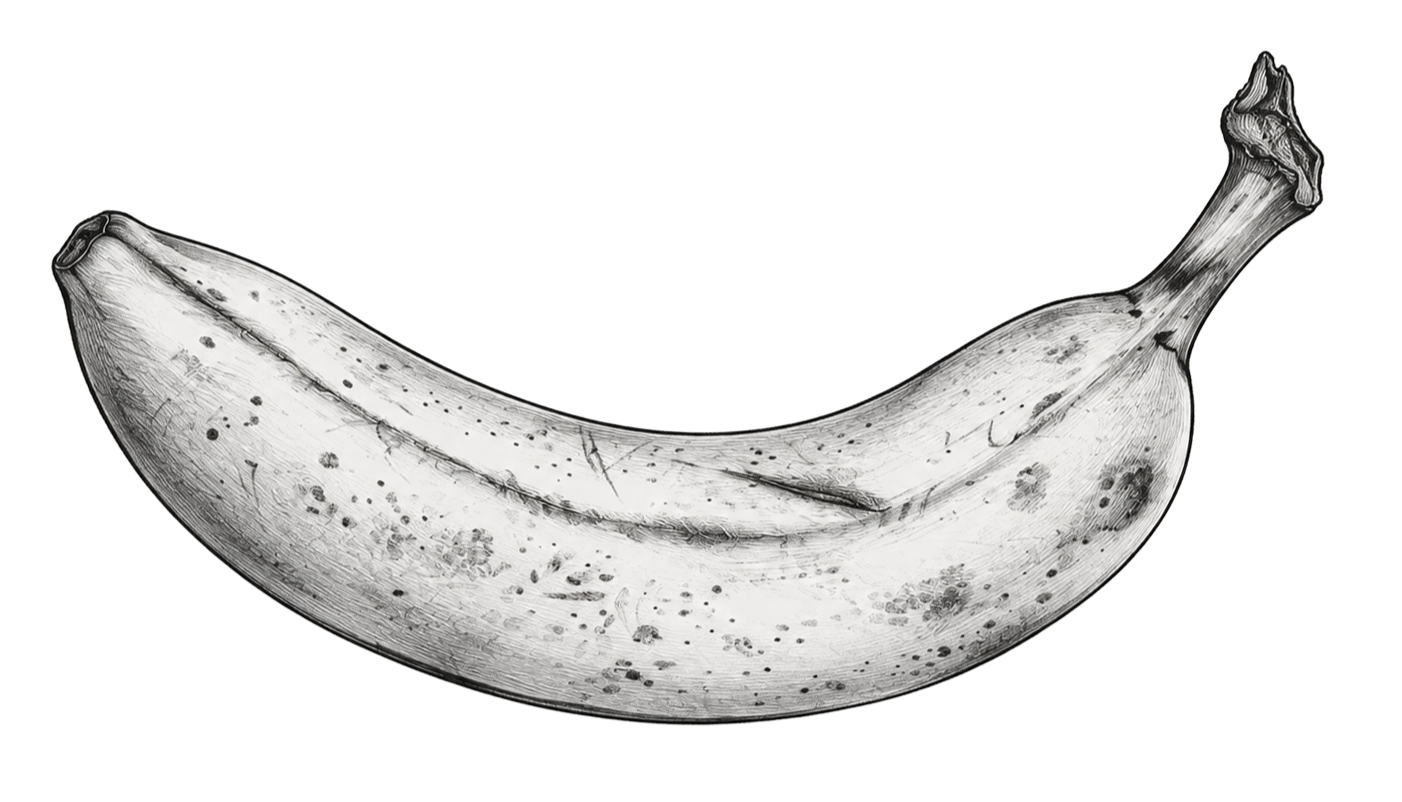
BANANA
Until the mid-20th century, Gros Michel was the dominant export banana. It had a creamy texture, a distinctive aroma, and a thick peel that made it well suited for transportation over long distances.
But the banana industry had built its success on a biological weakness.
Most of the bananas we eat contain almost no developed seeds. Instead of reproducing through conventional pollination, they are propagated by taking shoots from existing plants. Each new plant is a genetic copy of the original.
This is convenient for growers. All the bananas ripen at roughly the same time, look alike, and taste alike. But genetic uniformity also means that the plants often share the same vulnerabilities.
In the early 1900s, a serious disease began spreading through Gros Michel plantations. Known as Panama disease, it is caused by a soil-dwelling fungus, Fusarium oxysporum f. sp. cubense.
The fungus enters through the roots and attacks the plant’s vascular system – the network that transports water from the roots to the leaves. When this transport system becomes blocked, the plant wilts.
Worst of all, the fungus can survive in the soil for decades. This means that simply clearing an infected plantation and planting new bananas is not an option.
The solution was Cavendish, which was resistant to the strain of the fungus that attacked Gros Michel. Over the following decades, Cavendish took over much of the export market.
But now, another strain of the fungus, known as Tropical Race 4, or TR4, has begun attacking Cavendish. It has spread to banana-growing regions across several continents.
So we are facing a familiar problem: an industry built on enormous quantities of genetically almost identical plants.
Fortunately, Gros Michel is not extinct. It is still grown in some parts of the world. In fact, there are hundreds of banana varieties, with different shapes, colours, and flavours.